
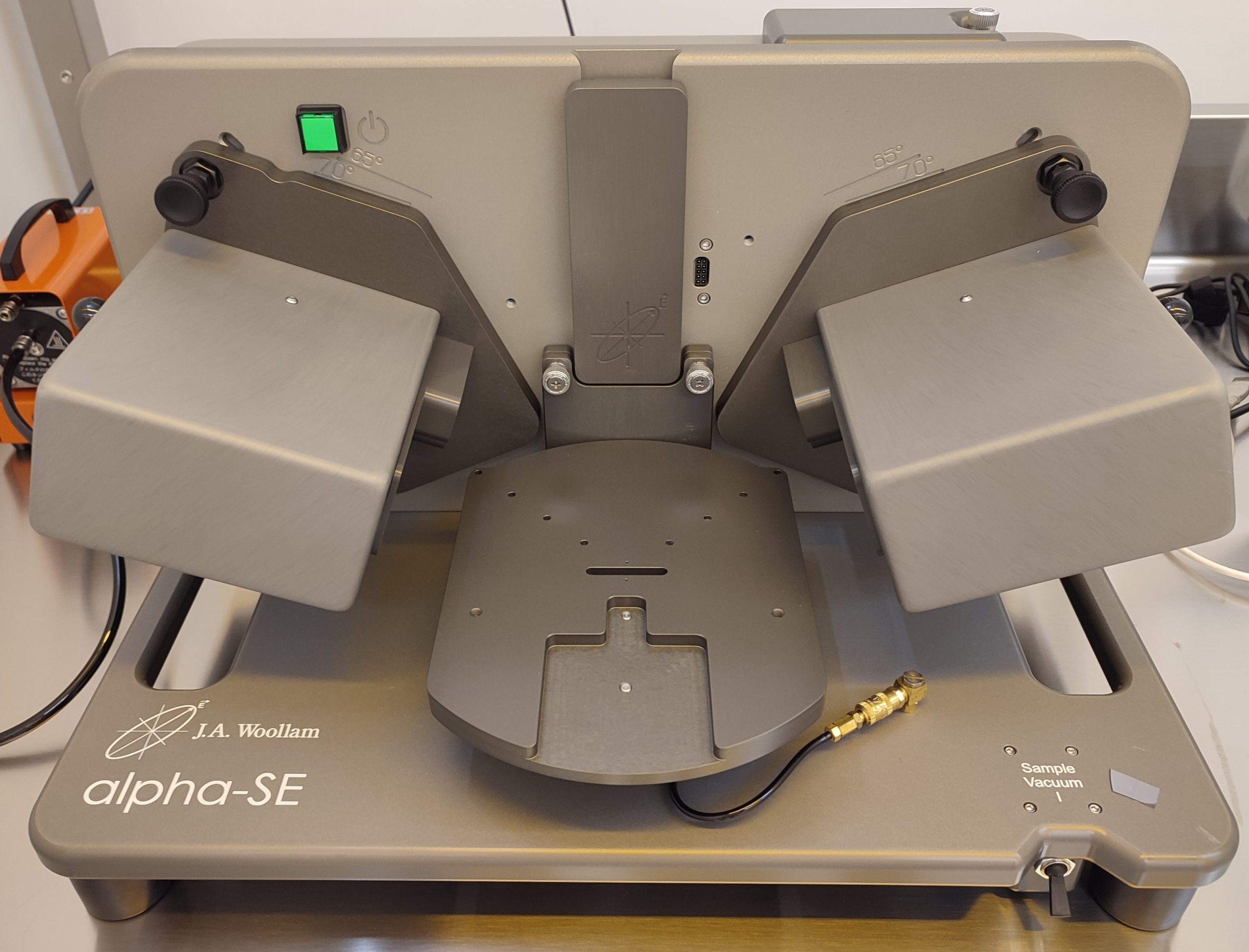
General description
Ellipsometry uses elliptically polarized light reflected off of the measurement sample to allow for extraction of both thickness and optical constants (n,k) for transparent and semi-transparent thin films.
- Elliptically polarized light is reflected from the measurement sample and is analyzed in p- and s- vector components.
- p- polarized light is in the plane of incidence
- s- polarized light is perpendicular to that plane.
- Reflected p- and s- light will have different amplitude and phase shifts which depend on optical properties of the substrate and thin film and the film thickness. Polarization of the light changes.
- The change in polarization is measured as:
- Delta (∆) is the phase shift between the two vector components of the elliptically polarized light.
- Tan(Psi) (Ψ) is the amplitude attenuation ratio of the two components.
- A model is fit to this data to extract thin film thickness and optical parameters.
Equipment name and Company: alpha-SE/J. A. Whollam
Technical specification
- Applications: transparent and adsorbing thin films thickness or optical constants measurements
- Types of film: metal, dielectric, organics, semiconducting single or multilayers.
- Wavelength range: 380 – 900 nm
- Number of wavelengths: 180
- Angles of incidence: 65°, 70°, 75°
- Complete spectrum acquisition rate: 3 s in fast mode, 10 s in standard mode, 30 s in high-precision mode
- Sample size: up to 200 mm in diameter and 16 mm thick
- Few steps: measurement of psi and delta, model, data fitting
- Good practice as recommended by Woollam: one-angle measurement is enough on thin film, three-angles measurements are best for thick films (t > 1 μm)